Monday, June 20, 2011

Hidden Message

After reading Trials and Tribulations it got me thinking about the way media and images has such control over our thinking. News systems carefully map out what they release and say to the public; images such as this one are released to prove that something happened but they also paint a picture with their words and using descriptive words or phrases to describe something. "Cooked and channeled, emotional investment rises and falls along the dramatic curve provided by the news systems" (p.20).
This perfectly illustrates the impact media has on us as well as other people. Reading about the Rodney Kind case enticed me to search for and watch the video and after watching it I felt that the video didn't just depict violence by the LAPD but it also lets viewers catch a glimpse of the evil that lurks inside people. The officers tried in the case defended themselves by saying that they feared for their lives and this was merely self defense but I truly do not believe this.
For more than 4 officers to fear for their lives by one man just seems extremely unbelievable and makes me question why some people, people that are supposed to be role models and mentors, would hold such a position. This video made me wonder why these individuals would want to be police officers if they were so easily convinced they were in danger. Personally I do not want to be "protected" by people who feel they are better than others and resort to unnecessary violence or those who are afraid or confrontation with a possible threat. Somewhere in there, there must be a happy medium or people who will protect those in the community with dignity and pride.

The Ring of Fire


Marianne Hirsch’s essay Projected Memory: Holocaust Photographs exposed a concept that was particularly interesting to me which was that of ‘postmemory’. She explains how especially camera images can capture an essence and become very ‘familiar and iconic’. Postmemory is this terms that she uses to describe when you remember an experience that maybe never actually happened to you when seeing a photograph. But it is not just is a level of remembering a certain even it is about linking it to your own experiences and maybe relating to it and to the people in the picture because in a sense you feel that you could be that person in the photograph. She mentions that sometimes these images can become so important in your life that you construct your own memories around it and in a sense they become part of you and something you experienced as well.

With the recent earthquakes in Chile and Japan I saw many pictures that made a great impact in my life and that really made me understand the point that Hirsch was explaining through postmemory. Ecuador is another country that is also on top of the Ring of Fire of the pacific, meaning that like those countries that suffered those terrible earthquakes we are too in the zone with most seismic risk in the world. We have had tragedies in the past because of this, which inevitably brought with it the eruption of several volcanoes as well. When I hear the news about the earthquakes especially the one in Chile (because it is so close), it was really shocking because it could have easily been us. When I see the faces of the people who suffered and lost everything I think about how it could have been here in Ecuador. So even though I have not lived through an earthquake I can easily sympathize with the victims of these earthquakes because it has happened here before and there is a great chance that it could happen in the future.

Sunday, June 19, 2011

Here's to Change

Gross' essay on "The Ethis of (Mis)representation" got me wondering if the media has changed any bit since the essay was released. After searching online, I found that the work was released in 1991. Depending on the subject or person, twenty years can be a short or long amount of time. I wanted to focus on the media, and if any changes (particularly positive) have occurred with the media's portrayal of homosexuality and heterosexism. Gross writes, "The rules of the mass media game have a double impact on gay people: not only do they pick and use weak and silly, or evil and corrupt, cliche'd characterizations, but they exclude and deny the existence of normal, unexceptional as well as exceptional lesbians and gay men"(196). I would like to propose otherwise. Though it has been (and still is) a long process, the media's portrayal of homosexuality is changing.

Ellen DeGeneres is a well known media personality and comedienne. In 1997, DeGeneres came out on public television as a lesbian. If Gross' interpretations of this subject are true, the public and media would have shunned her. Her career would have gone to waste. However, it didn't and Ellen Degeneres career thrived. She went on to have her own talk show in 2003, which is still on the air. The quote from Gross that I included above does not seem to apply to DeGeneres. Here is an openly gay woman, who has gone on to have great success. The part that makes me think Gross is wrong about the media is that the show Degeneres hosts is not defined by her sexuality, but by her personality. She is a talk show host, like any other, that discusses current issues, has guests, tells jokes, and even dances with the audience.
I like to believe that our culture and society is changing. That we are becoming more open and accustomed to lifestyles that may be different from our own. While Gross' essay certainly has its merits and evidence to back it up, I am of the belief that the media, and with it society and culture, are evolving to become more accepting.

Saturday, June 18, 2011

Gross- Heterosexism

Gross seemed to give reasons as to why our society looks at homosexuals the way that they do. He blames mass media, like television, and movies. Gross states that “Heterosexism represents the belief that a particular complex of culturally defined sex and gender roles and responses is natural, that other configurations are unnatural-deficient, diseased or delinquent- and, again, that these differences represent a value dimension in which the ‘natural’ is the better alternative” (Gross,193). Gross brings up a solid point when he talks about how mass media outlets play a vital role is social definition for men and women. “in the absence of adequate information in their non-mediated environment, most people, gay or straight, may have little choice other to accept the narrow and negative stereotypes they encounter as being representative of gay people” (195). Heterosexism is so evident in our way of watching the media and that in itself instills the views that we have about our society and culture.


A solid example of this, as an avid Soprano’s viewer was in when Tony and the crew shot and killed Vito because he was gay. This shows a direct correlation to the power that the media has to show the “power” heterosexuals have over homosexuals. What Gross explains is that the history of homosexuals and in particular heterosexism among mass media outlets does not seem to be changing. “There surely are opportunities in the new communications order for more equitable and morally justifiable structures and practices, but I am not sure we can get there from here” (201). Our society and culture seems to stubborn about change.

Friday, June 17, 2011

I had to read this piece a few times to really understand it (or at least pull out a few key ideas).

I found the advertising/image ideas of Rosiland Coward and Myers quite interesting. I am sure we have all paged through fashion magazines at some point in our lives. Many of these magazines are full of advertisements for fashion, jewelry, and cologne and contain photographs of scantily clad men and woman. Many times, that may be all the advertisement contains.

I decided to search for the original advertisement of the Guess? Jeans ad from our reading. Even though the photo was shot in black and white and altered to give it hues of gold and bronze, I feel this advertisement is pushing the limits and can quite possibly be considered pornographic.

I am not a prude by any means, but a mom to 2 daughters and would have a lot of explaining to do if they were to see this advertisement in a magazine and wonder why these naked people are an ad for men’s cologne.

I assume the majority of my fellow classmates are true college aged students. I would be curious to hear what you think of this photograph.

Wednesday, June 15, 2011

Mind Bombs and Meat

In reading DeLuca's essay on mind bombs and what they aim to accomplish, I kept thinking of a certain organization's print ads that do NOT aim to enact political change. This organization does the same things with their ads that most other companies try to do - attract a broad audience. They use barely clothed women and catchy slogans. Yet, unlike Greenpeace or Amnesty International or some other NPO that works for the greater good of the world and is almost unanimously supported and respected, this particular organization is hated by many who do not support it's ideals...


This organization is PETA, an often radical animal rights advocacy group. The ad above, featuring a fully nude Roselyn Sanchez, is just one of a number of ads in PETA's "I'd rather go naked than wear fur" campaign. But why does an ad campaign such as this one, featuring such gorgeous women like Ms. Sanchez less than clothed, fail. It is because of the message behind the campaign. The campaign featured in DeLuca's essay that dealt with Soviet whaling was encouraging us to help save the whales. PETA is also trying to help save animals, but they are doing it at the expense of other people's way of life. Who are they to tell us not to wear fur? Who are they to tell us that "meat is murder?" It is a known fact that people don't like being told what to do, and people probably like being told what NOT to do even less. Furthermore, while the whaling ad and fur ads both point to an enemy, it is interesting to note who the enemies are. The Greenpeace ad points to the whalers as the enemies, the PETA ad points to...wait, what?...yep, it points to YOU. Kinda hard to get behind an advertisement that paints yourself as the villain, isn't it? So while both ads are similar in a sense, they are different in their motivation and their target, which leads me to believe that is why one succeeds and the other fails.

Mini Mind Bomb

http://www.youtube.com/watch?v=9gspElv1yvc

This link is to the Sara McLachlan Animal Cruelty Video. I am sure some of you have seen this commercial on television, but it reminded me of a mini mind bomb because it shows all the sad image of suffering animals and presents an opportunity to help them through the SPCA. I wonder if people are really affected by this, sure it is dramatic, but if you see it multiple times on TV does it really have the same affect each time? It lacks the intensity and controversiality of a mind bomb, but it is trying to go with the mind bomb affect by making the atrocities known to the public. There is no specific "bad guy" that is targeted in this commercial, but it is evident that there is an ongoing problem that some people want to change. So I guess instead of a full blown mind bomb, this commercial could be considered more of a kick in the shin -- it will knock you off your feet at first, but then it goes away after a while, until you see it again. Instead of blowing up your brain and leaving a lasting impression, it creates a bruise that eventually heals and goes away.

Barthes Rhetoric of the Image- Reflection


Advertisers are constantly trying to grab the attention of a viewer. Using rhetoric theory, an advertiser will take a poster, design it in such a way so a person will stop for a moment, review it, digest it, and be influenced take action (buying a product, service, etc.). Take the ad above for instance. You might walk by this poster, glance at it and say, what is going on here. The consistently light background draws your eye to search for something. You find a spot to look and that is the center where you see a strand of hair going through some liquid. You wonder, what is the purpose of this? You seek for a definition that leads you to look for something. Normally you would look from left to right and then downward. But nothing is on the left so you see that there is a dark colored bottle in upper right with small text above it. You might step up to the poster to read what the text is that says “for thick hair”. You then realize this must be some kind of shampoo, you look at the bottle and it is. You have now have been hooked, you looked, you consumed what was being conveyed, you figured out what the hidden message is (hair shows thicker in the liquid), you discover it is Parachute shampoo, you have an ah ha moment and a “that’s cleaver” moment. That adds a feeling to the message which in turn will allow for a better memory to be created. Parachute shampoo is the linguistic piece of the photo and it is very easy to see how creative advertising ties in the photo to the linguistic messaging.

Amy Komsa June 15, 2011


"Ways of seeing are culturally imbued codes which are consistent across not only advertising images but other visual images as well such as oil painting and portraiture. This consistency in representation helps define what is “natural” to be seen and enjoyed. Cultural ways of seeing are instrumental in allowing the argument that visual images, especially advertising images, are merely “reflections” of the larger society and its social relations. "

Gender effects how the ad is “decoded”. A man may see this ad below and buy the product for he wants to attract women that look like the model, while women may see the model and feel a pressure to look like the model, because if she does not she will not attract men. In our sexually oriented world this is a very important issue.

Advertisers, or the “encoders” create their ads with a specific image in mind. They want their viewers to view this ad and think exactly what they had planned. One way in doing so is by adding speech/words to the “text” which reduces multiple meanings. In this Axe (or Lynx in the UK) you can see that the use of words on the ad has influenced how the ad is interpreted. Our culture is very sexual and this ad is used to sell their product. In fact the product itself is not even in the ad. There is a small image of the product in the bottom right hand corner. Instead you see an attractive woman’s body (no face), that is “dirty”. This visually appeals to males and they are more likely to buy this shower gel because they want girls that are “dirty” to want them to “wash them”.
People will buy Axe (Lynx) over other shower gels that do not appeal to them sexually. Will this shower gel actually help the men find situations with model girls throwing themselves at the men, probably not, but advertisers use the power of seeing to draw in costumers.
This advertisement is very similar to Haug’s argument that sexuality can be visually attached to almost any product and therefore give the product value. The half dressed girl hardly relates to the men’s body wash, but the visual sight of her in the advertisement creates a bond between a girl in a bathing suit and axe and therefore when picking out a shower gel the image may pop into the buyers head and make them want to buy this product over another. Ultimately the sellers are selling “sex” rather then their product.
Annett Kuhn states that visions of women have culturally been seen as the property of a men. Women in today’s society are objects rather then women. This women in this ad does not even have a face. She is merely a body, and the man who is using this product is able to do what he wants with her. The advertisers let this image stay ambiguous, you are not sure if she is blonde or brunette or if she is asian or Hispanic, etc. instead as the decoder you are able to imagine what you want with her.
Women are used often as sex symbols in advertisements, and whether its beer, cars, gum, jeans or anything the product is able to use the sexuality to sell the product.

representation through new words


After watching Marlon’s video about how representation was at work with the term “LIGAS” among his friends, I immediately thought of all the slang that is part of the different subcultures I’m a part of. There are so many terms that are unique to my group of friends, my group of peers, and my age/socioeconomic/gender group nationwide. These terms would have absolutely no meaning to someone outside the group, as the meaning for these linguistic symbols is exclusive to the group’s members. Those on the outside would be clueless as to what we’re talking about.

Within my sorority, a couple girls started throwing around the word “gehl" (as a sort of slang for the word “gal”) and its meaning relies on its use and who is using it. We always say it in a certain tone, and always in a sarcastic, silly way. You can refer to someone as a “silly gehl” or a “working gehl” or a “tired gehl.” But to anyone who isn’t in my sorority or my group of friends must think we’re crazy. Why are these girls saying a simple word in such a ridiculous way? The meaning of the word is within the culture. A gehl is just a girl, but its representation to our group has a certain intangible nature to it. It’s a certain kind of girl, but it only really makes sense to us. I recently found out that Gehl is an agriculture machinery company, so to alot of people, the same word has a totally different meaning. But if I were to ask my mother, who is neither in my sorority nor in the agriculture business, gehl is probably just a nonsense word.

Another example that goes a little broader is the “betch” craze thats sweeping the college-aged girl world. A “betch,” which isn’t a real word but something that we’ve put meaning on, is a certain girl, similar to a “gehl,” who is savvy and sassy and generally awesome. She puts herself first and doesn’t care who is hurt in the process. Yet this term was defined by a certain group, and is only understood by that culture. The posts on the betcheslovethissite.com website refer to a certain socioeconomic group of college girls who value certain things, and such values would have no meaning to someone outside the group. An outsider would think that betch is a misspelling of “bitch,” but it is far from that to those who have helped shape the meaning of the word.

New words and slang provide a clear indication of representation; the group that makes the word makes the meaning. These are only a could words that I'm personally familiar with; as a member of these groups, i'm inherently left out on the meaning of other new slang words, until the word gains some personal cultural value for me.

Rhetoric of the Image- Barthes


Great advertisement right here! The first thing that this image does is grab your attention to the man in the full body cast. He looks like a mummy. Then you start wondering what this ad is for. You look down, see the LaZer bike helmet symbol and look back up to the guy and realize that the top of his head is completely fine. You have to kind of smile/laugh at this one, it’s a great ad. The linguistic part of the image is short and to the point: LAZER Bike Helmets. What else needs to be said?

The most important thing about this ad, that you see a connection between the linguistic message and the visual image that the advertisement conveys. It “speaks” to us. Just like Barthes says in his chapter titled Rhetoric of the Image.

“If the image contains signs, we can be sure that in advertising these signs are full, formed with a view to the optimum reading: the advertising image is frank, or at least emphatic” (Barthes pp.33).

Tuesday, June 14, 2011


I thought this picture was helpful for me since I am a visual learner. Maybe it will help some of you. This triangle helps to show the connections and importance of the rhetoric levels.

Something else I noticed as I was trying to find something to post to this blog, is that any time I would search rhetoric of images, denoted images, or anything relating to the Barthes article, was about death or politics. There always seemed to be a negative example of real advertisements and images that people criticize and really try to analyze. It seems that our society focuses on the negatives more than the positives and that people are so critical of each other.Barthes article did not focus on just good at bad, he just analyzed images, and it seems that our society only knows how to analyze images and people in a negative way.

Changes in Advertising

According to Shield and the website that I came across, advertising has changed and advanced over the years, Shield even dates back to the 1800’s. Not only are the purposes and messages of ads being portrayed differently, but the tactics and strategies also.

I came across this online http://www.gisbergen.eu/paper3e.html and its really interesting as it explains the changes in specifically magazine advertisements just over a short time period of 20 years; from 1980 to 2000. What is truly amazing is how much can change in that amount of time.

In Shield’s article, it states that in 1890 to 1910 advertisements were focused on the utility of the product being advertised and later in the 50s and 60s advertising became narcissistic and people judged products interpersonally. And then starting in the 70s until now, advertising is geared and directed more towards imagery on lifestyle. “Today, many product images are totems for lifestyle achievements and subgroup membership” (28).

I find it interesting to see how advertising began with an emphasis on utility and the use value of a product to now almost materialistic and status symbols relating to lifestyles. The fact that “Lifestyle advertisements and advertisements that simply capture a “look” are purposefully ambiguous”- that way people can interpret the image how they want and desire to own the product in their own manner. These changes and advancements in advertising goes to show how culturally embedded this type of media is and how influential It is on society.

"Stay Thirsty My Friends"

Shields' article on "ways of seeing" and "ways of looking" got me thinking about some of my favorite advertisements, and why I believe them to be affective. First, Shields defines "ways of seeing" as, "culturally imbued codes which are consistent across not only advertising images but other visual images as well..."(26). Second, "Ways of looking" are, "the address of the image to its spectators"(26).
The first advertisement is the always classic Geico Caveman commercials.

Shields suggests that advertising, today, is about showing the viewer's an ideal lifestyle. The Geico caveman commercials are not only funny, but also adhere to this idea. The suggestion being that Geico is so simple even a caveman can use it provides viewers with an ideal service that is simple to use and for everyone. The choice of the caveman character is also significant. It seems to suggest that if you do not use this service, you are outdated.

The next advertising campaign is probably my favorite of all time.


The Dos Equis commercials are a great example of Shields' view on advertising. This commercial attempts to attract the viewer using humor, and I believe does a great job of doing so. Effective advertising stays with you, and I always enjoy watching these commercials and will watch them on Youtube.
Shields' "ways of seeing" and "ways of looking" come in to play with the DOs Equis commercial as well. The commercial shows a character with masculine traits, an adventurous lifestyle, and glamour. Society sees these as desirable traits in a man. A cultured, adventurous, bearded guy. The main message of this commercial is if you drink Dos Equis, your lifestyle will be improved and perhaps you can even become as epic as "The most interesting man in the world."
The most important trait of these commercials is humor. Humor sticks with people. After seeing most of these commercials for the first time, I would bring them up in conversation. This is why these advertisers are good. By using humor, they guaranteed a spread of their products via word of mouth.

ipad.jpgShields talks about how “the fashion image promises satisfaction upon obtaining ‘the look’ and the look can (and must) be purchased” (32). This is seen within every advertisement, hence the point of it being advertised. But mostly everything looks the same, doesn’t it? Girls, how many times have you looked in People Magazine and the new collection for summer or fall clothing is out and it looks like everyone is wearing the same color and same type of clothing? It starts with one designer and once the secret is out, every designer then makes the same type of style, but said to have their own “unique” touch and make just a little cheaper for the consumers’ liking. When thinking of this, we see these articles of clothing, but do we really go through each one trying to find the best, even when they look like each other? I know I just look at the price and if it looks good I get it. Switching gears now, what about the iPad. The iPad came out and maybe a month later, every other phone network came out with the same type of device, but cheaper. Even though the iPad is said to be the best, when we look at all the other devices that came out, we see the same thing. It’s the “look.” But if we really see what each of them have to offer then we can make an accurate decision. The advertising world is deceiving, but it also works to manipulate people’s minds!

http://www.dutchdailynews.com/wp-content/uploads/ipad.jpg

Monday, June 13, 2011

SIN PIEL


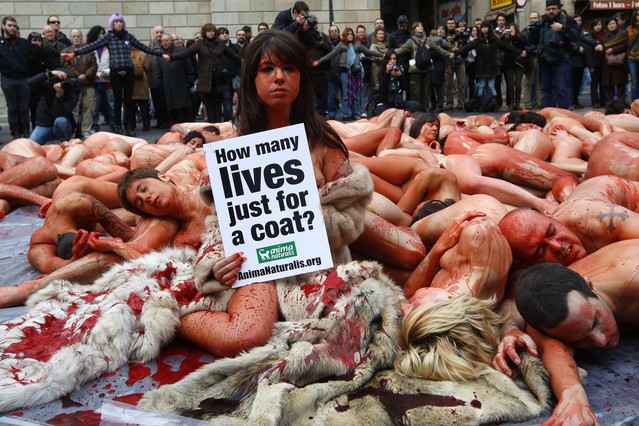
Reading Deluca’s Image Politics really made me think of how important a visual image can be in impacting people’s choices. When reading about the ‘mind bombs’ and how much influence they had on important policies. It made me think of how even though it is people in power than have the ultimate say on the issues, normal people are more than them; we have the ultimate say of things. If everyone disagrees on a certain topic then they will have to change their policies to please us and keep their position of power. One of the most amazing ‘image-events’ I have seen was organized by a Hispanic organization called Animanaturalis.org that has as a purpose to spread and defend the rights of all animals. This was a protest done in 2009 in Madrid, it is a part of annual protest called Sin Piel (without skin) which is done to raise awareness and to stop the fur industry.

This installation consisted of volunteers being naked and poured with fake blood laying in the floor with donated fur coats being taken off while one of them spoke facts about the cause. This is only one of the ‘mind bombs’ done by this organization there have also been flash mobs and other types of protests which can be seen in the website (http://www.sinpiel.org/). Its intention was to attract the people that were passing by this very public place and for them to listen, the media soon found out and immediately they were all there witnessing it. Their main purpose was for regular people to listen to what they had to say, because they have no political affiliation they had no intention in targeting a specific political figure. They know that the change in policies can only come from the changes of attitudes of the people. In this sense they have been very successful because each time there are more people adding to the cause, there are thousands of volunteers and now there are representatives in this organization in more than 10 Hispanic countries (one of them Ecuador). Personally I can see that their activities have been effective because recently the organization here in Ecuador did a very strong campaign against bullfights which are a very significant and old tradition here in Ecuador. To the shock of everyone in the last popular consult a law prohibiting bullfights in Quito (host to one of the most important ‘ferias taurinas’ or bullfighting events in Latin America) won. This is just one of the many examples of how this organization is achieving changes in policies through their daring and graphic visual protests.


http://www.youtube.com/watch?v=p9w5BlXKSq8&feature=related


Thursday, June 9, 2011

A typical family portrait is usually set with the man or father standing behind the rest of the subjects while the others sit or are short enough to stand. The way that women are made to sit in these types of photos makes surrenders them to the role of "passive/female" as described by Shields, while the men take on the "active/male" role. It may seem like a lot to draw from a simple family portrait but images can convey so many meanings and this is just one image of hundreds of thousands circulating around the globe that portray the power struggle even more vividly than this photo. Hard- and soft-core porn also portray this dichotomy in a more graphic and pressing way. These portrayals of the male/female relationship such as the way a man stares and the way women play into that by worrying about there appearance; all of this turns women into objects and the woman is the one who does it the most because no matter how much they may deny it most enjoy the attention from men as they walk down the street.
This brings me to my next point--There have been many scandals of famous actors and professional athletes (all male) that have been charged with sending pornographic text messages to women. Some men think it is okay to send pictures of their genitals to women they speak to but the reality is that they do not enjoy it--nobody really wants to see that, honestly. On the other hand many women send pictures of themselves to men all the time but the fact is no one ever really finds out about it because they are not repulsed or put off by this action. The media seems to make such a big deal about men exposing themselves to women but you rarely, if ever, here the opposite. It is a bit of a double standard that favors women but it doesn't seem to be going away but something to keep in mind when looking at ads, pictures, books, etc.

Wednesday, June 8, 2011

The Undependability of Periphery

In the third Elkins' reading "Looking Away, Seeing Too Much," there is a small thing mentioned that a lot of people don't realize unless they truly think about it. That is, our peripheral vision is completely undependable. You might be thinking "What do you mean? My peripheral vision is fine!" While it may be true that you notice things in your peripheral vision, you can't really comprehend them. A little home test - turn on your TV to a random channel and put it on mute, then look just off to the left or right of the screen. After a few seconds, rewind your DVR and watch it again. If you can tell me in good conscience that you saw EXACTLY what was going on on your television screen, then congratulations, you're a medical marvel. Chances are though, all you saw were colors, shapes, and movement. The things that we "see" in our periphery aren't usually all that important, but it is a definite reminder that no matter how clear a picture we think we have of the world we look at, our eyes really can't capture the whole scene. Below I included a link for a little bit more official field of vision test.

http://www.testvision.org/

Elkins chapter 3: Deflected Seeing


Rest In Peace, Grandfather.

I apologize for this blog post being late but I did it intentionally. Earlier this week my Grandfather passed away. Yesterday was the wake and today was the funeral. I wanted to wait until after these two events to reflect on how my vision was deflected over the past week since I had last seen him in his hospital bed looking like half the man (in weight) that I have "seen" and "known" for 21 years. I want to recall three instances of personal deflected seeing related to death from this past week.

First, I want to share with you all that this is my first first-hand experience with death and any horrible illness like cancer, so this is all new to me. The visit I had with my Grandfather about three months ago was the first time physical signs of his illness had become noticeable, although they were not drastic. In this instance I rate my "deflected seeing" rather low because although he seemed to have lost a few pounds and wasn't as mobile as he normally was (this was a man who walked 4 miles everyday for the past 40+years), he was still as mentally sharp, whitty, and characteristically funny as always. Sitting there visiting with him wasn't much different than any visit I had ever had with him, and the physical signs of his illness were similar to someone getting over a cold or fighting the flu, not someone who was fighting cancer. In this instance I saw my Grandfather as someone who was sick, not someone who was dying.

The second instance was when I visited him in the hospital a few days before he passed away. By now the physical deterioration had become overwhelmingly noticeable as it caused severe weight loss and extremely limited mobility of any of his extremities. Furthermore, his speech had become nearly obsolete, a characteristic that has truly made him the man he is with his clever puns, jokes, and witty banter. Although I couldn't deny the sight of him before my eyes, I deflected my seeing by still visioning him as the man I have known my whole life. I can recall how hard it was for me to make eye contact with him and shifted much of my line of sight to the others in the room during conversation, picturing he was just his old self sitting there in the bed. I can recall looking directly at his face and seeing it in my eyes but in my mind I projected the face that I have always seen before he got sick. Although I could no longer deflect the reality of his dying state, I still held on to the image of what he used to look like.

Finally, the wake and funeral services proved to be another instance of deflected seeing, although this time it wasn't the sight of his physical face and body, but rather through pictures and storeis. Today was like talking about someone who was supposed to come to the party but missed their flight and couldn't make it - like they were alive and well somewhere else but just not present here. The cheerful mourning and funeral setting were both reminders of reality but also of the past, which I (it is difficult to explain) both consciously and unconsciously saw or "visioned" Grandfather of yesteryear.

Whenever I hear his name or think of a reference or connection to him who do I think of? Who and what do I picture? The cliche is that first impressions are everything and what people most remember, and I believe this to be the case. I think of my Grandfather from my earliest memories. I picture him as all the man who grew old and aged well until became sick. I picture the conversations, the room we were in, the places we went, the things we did overwhelmingly more than the past 5 months. Anytime an image or recollection of him in his illness pops into my head it is hard to tell whether it is conscious or unconscious action that immediately deflects those painful images away and recalls the good ones. Either way, deflected seeing is a reality in itself which allows us to cope with life and move forward as it acknowledges reality but soothes the mind and the soul.


http://www.legacy.com/obituaries/philly/obituary.aspx?n=eugene-p-simonson&pid=151655994&fhid=4331